
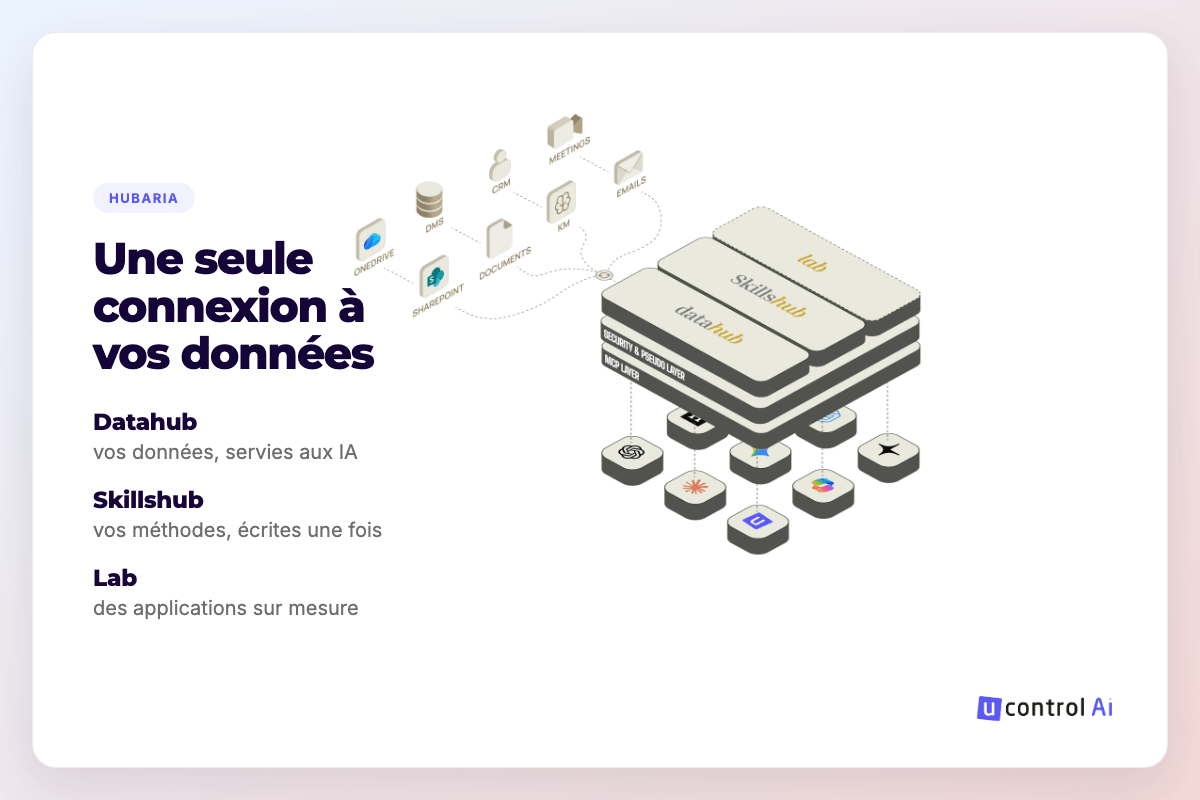
In all the AI projects we run, with legal departments and law firms alike, we end up facing the same question. The choice of model takes a back seat. The crux of it is data: being able to connect it to the AI, and to do so securely.
Delivering data to the AI, with the right level of protection
Not all data is handled the same way, and neither are all AIs. Depending on which AI receives the document, and on the document itself, you need more or less protection.
Sometimes you have to pseudonymise. Every person, company and place becomes a code before anything is sent, and the real names stay encrypted separately. They are restored only for authorised people, and every re-identification is logged. In every case, access rights apply: everyone sees only the matters they are entitled to.
So it is not a matter of sending everything or nothing. The same data can leave more or less protected, depending on the AI receiving it.
Putting it in context: a document never arrives alone
Delivering the data is not enough, it also has to be put in context. Take a contract. For the AI to understand it, you often need to send its annexes and its updates too: the amendments, the successive versions. Without them, the AI may read version 3 of a lease without knowing that a signed version 5 exists, or that an amendment changed a clause.
It also has to be split up. A contract is cut by article, a table by row, a meeting by speaker turn. That splitting is what lets the AI find the right passage instead of getting lost in a long document.
In practice, when a document arrives in the Datahub, it is read (with character recognition for a scan), typed (contract, lease, invoice, summons…), split according to its type, pseudonymised, then described: the parties, the dates, the amounts, the status. It is then indexed, so it can be found by words and by meaning. And it is linked to the others: this version replaces that one, this amendment modifies it, this annex accompanies it.
An example. You ask: “Give me the latest version of the lease and what changed it.” Without links between documents, the AI receives eleven documents, emails included, and may answer with a version that was never signed. With links, it receives three: the version that prevails and the two amendments that modify it. It reads less, lands on the right version, and knows who the parties are.
A second memory
That is why we talk about a second memory. A firm already has a memory, but it is scattered: documents in the DMS, exchanges in emails, decisions in meeting minutes, deadlines in calendars. No AI sees all of that at once.
The Datahub does four things:
- Gather: your sources are connected once.
- Match: one matter, all its sources.
- Protect: your access rights are applied and names are replaced by pseudonyms.
- Serve: every AI receives the same data, whether it is Claude, ChatGPT, Copilot or uControlAi.
You can then ask it everyday questions:
- “Have we already negotiated this clause?” The contracts that contain it, how it evolved, and the argument that carried the decision.
- “What falls due this month?” Hearings, deadlines and pending reminders, found in calendars, emails and deeds.
- “I’m taking over this matter, what do I need to know?” The history, the positions already argued, the contacts and the next steps.
Your data stays yours, secure, never handed to an AI in the clear. For more on the module, see the Datahub page.